

Economic Commentary
The US Federal Reserve (“the Fed”) held firm to its “wait and see” approach to interest rate policy in the first quarter of 2025, electing to hold rates unchanged until they can assess the full impact of the Trump administration’s tariffs and government layoffs. The trade policies in particular have introduced a level of uncertainty into economic forecasts from the Fed and other experts, due to the continuously shifting nature of the tariffs in scope and timing. President Trump’s aggressive negotiating tactic is an attempt to capitalize on a position of strength since the US accounts for roughly one-third of of global consumption.
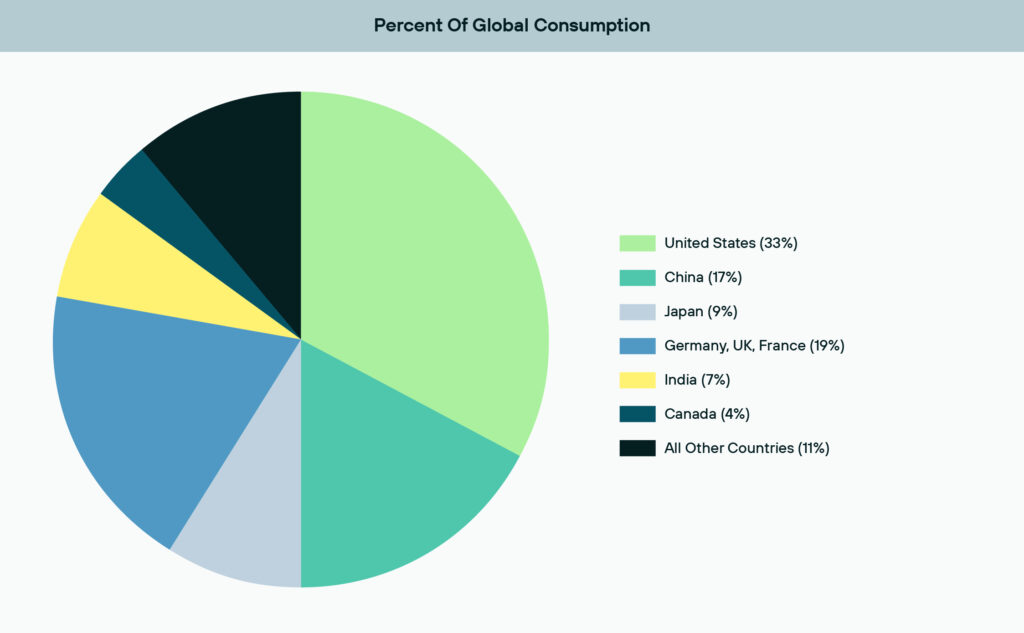
If Trump can extract concessions from trading partners and attract capital investment into the US without a prolonged trade war, the hardline approach may prove to have been worth the short-term market turmoil. On the other hand, a prolonged tit-for-tat exchange of tariffs will ultimately result in higher prices being passed on to consumers, reigniting the inflation that the Fed has long struggled to contain. The historic low unemployment, which has afforded the Fed the ability to be slow and deliberate with rate cuts, could also be in jeopardy as tariffs – both domestic and reciprocal – could lead to layoffs during a drawn-out trade dispute.
Given the trade war’s impact on both sides of the Fed’s “dual mandate” of price stability (inflation) and employment, we can expect the Fed to remain on hold for as long as possible as it attempts to accurately model the constantly shifting trade dynamics. At the March Federal Open Market Committee, Chairman Powell suggested the Fed views the tariffs as a “transitory”, one-off price increase, but also recognized the difficulty involved in distilling tariff-driven inflation from more embedded inflationary trends.
The Fed has updated its year-end core inflation projection from 2.5% to 2.8% while also lowering its year-end Gross Domestic Product (GDP) forecast from 2.1% to 1.7%.
The upward revision to inflation accompanied by lower GDP outlook raises the specter of “stagflation”, although those concerns are likely premature given the still-low unemployment rate of 4.1% and the fact that the Fed does have some “dry-powder” to implement via rate cuts. While the Fed has kept its finger off the trigger on rate cuts, it has slowed the pace of its balance sheet runoff to relieve pressure on bond yields.
Market Commentary
In Q1, 2025, the benefits of asset allocation diversification returned and paid off! US stocks entered 2025 looking uncertain after a choppy December, but accelerated to new highs in January on a broad-based rally that finally saw strong participation from stocks outside the “Magnificent Seven” mega-caps that accounted for most of the S&P 500 gains over the past several years. Corporate profit growth in the fourth quarter of 2024 was the best since 2021, which provided some hope that the rally could continue. The momentum for artificial intelligence (“AI”) stocks abruptly stalled in late January, however, on news reports highlighting potential advances in lower-cost, more efficient Chinese AI competitors. Investors pulled back on exposure to Mag 7 companies as they questioned whether the AI spending spree would continue if cheaper alternatives evolved.
Despite the pullback in the high-growth mega-caps of the Technology and Communications Services sectors, stocks were able to grind higher through mid-February as market breadth (the count of advancing vs. declining stocks) broadened out. There was a significant rotation out of growth and into value stocks, which can be considered a healthy move considering that the concentration of the top 10 stocks in the S&P 500 had grown to an all-time high of 38% at its peak.
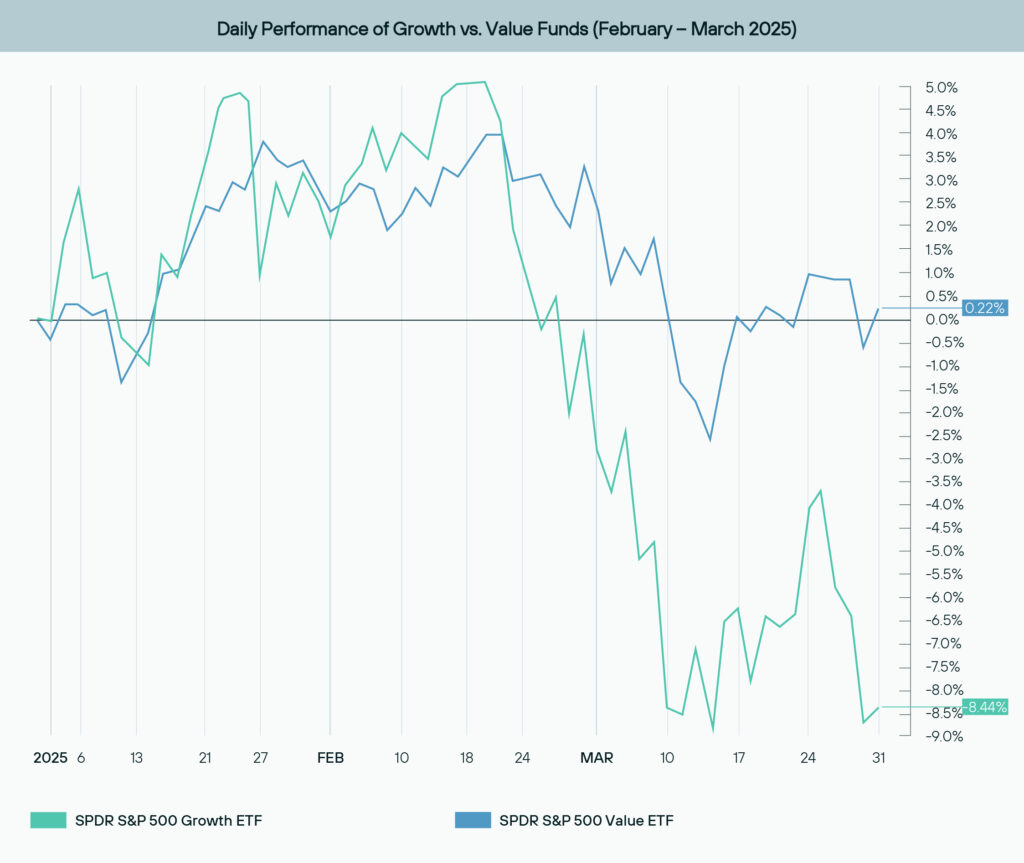
At the end of Q1, 2025, Energy stocks were the best performing US sector, up nearly 10% in aggregate, benefiting from the aggressive cutbacks of regulations and environmental protection policies. Health Care and Utilities also were relative outperformers, while Technology and Consumer Discretionary stocks lagged significantly. While we entered the year with big tech valuations looking a bit high, some of the mega cap stocks have pulled back to forward P/E levels that now look attractive given earnings expectations and the upside potential of AI implementation.
Concerns over tariffs caused stocks to pull back across the board at the end of the first quarter due to the potential impact on US economic growth and inflation, and the market has now given up all its post-election gains. The Trump administration has shrugged off the possibility of a recession and appears willing to put the markets and economy through some short-term pain in exchange for trade-war wins. While some economic models such as the Atlanta Fed’s GDPNow have begun to flash warning signs of a possible recession, the corporate bond market is not showing any major signs of concern as spreads remain very tight by historical comparison.
US small cap stocks have been a casualty of the Fed’s rate cut pause, although conventional wisdom suggests that small caps could be relative outperformers during a prolonged trade dispute over large multinational companies, since many small caps manufacture and sell goods domestically. Thus far, small caps have been laggards, down over 7% in the first quarter, although mid cap stocks have shown some relative outperformance over large caps and are down less than 2% in Q1.
Foreign stocks have also outperformed their US peers in 2025, bucking the trend of significant underperformance that has persisted since the Global Financial Crisis of 2008. Developed Foreign stocks are up over 8% in the first quarter, while Emerging Markets are also positive with a 4.5% gain. The outperformance can be attributed to a rotation out of high-P/E-multiple US growth stocks into much cheaper European equities, as well as dovish central bank policies overseas while the US Federal Reserve holds rates steady. Since 2024, the European Central Bank has cut interest rates six times, to 2.5%, while the US Fed has only implemented three cuts to bring rates to the present range of 4.25 to 4.5%.
Treasury yields spiked at the onset of 2025, but eased during the quarter, mostly attributable to reduced growth expectations and a modest uptick in the likelihood of a recession. The 10-Year US Treasury yield appeared poised to retest 5% early in the quarter but eventually retreated to end the quarter at 4.2%. The yield curve has gotten much closer to its “normal” shape, although six-month to seven-year yields remain inverted at lower yields than ultra-short government debt, which is yielding around 4.3%.
Corporate bond spreads remained tight during the quarter, performing surprisingly well given the concerns over potential economic fallout from tariffs and government layoffs. Investment Grade spreads remain under 1% at quarter-end. High yield bond spreads ticked up a bit from their January low of 2.6% to reach 3.2% at the end of the quarter, still well below their long-term average of 5.3%. Experience shows that when recession concerns arise, the bond market typically reacts earlier than the stock market. The corporate bond market’s subdued reaction to the trade war drama suggests that bond investors do not believe a recession is imminent, at least for the time being.
Closing Remarks
Caution in the markets has risen and could persist as tariff negotiations continue. It is likely we will see some conservative earnings revisions when companies report their first quarter results as CEOs attempt to navigate the uncertainty, which could lead to some additional choppiness even if first quarter earnings are good. Still, the economy appears strong enough to weather a temporary disruption with moderating inflation, a solid jobs market, rising earnings growth, and mostly undeterred consumer consumption. Fundamentally, little has changed in the economy and the adverse impact of tariffs could vanish just as quickly as it appeared, if deals are struck.
Thank you for the opportunity to be of service.