

WEEKLY MARKET SUMMARY
Global Equities: A sharp, semiconductor-led selloff drove U.S. stocks to their first losing week in three, snapping a recent run of gains. The S&P 500 fell -1.6% and the Nasdaq Composite dropped -2.9%, while the Dow Jones Industrial Average fared better with a -0.9% decline. Weakness in chips dragged overall markets lower as the PHLX Semiconductor Index (SOX) sank roughly -10% and slid into a bear market. Small caps were relative outperformers as the Russell 2000 dipped just -0.5% during the week. Developed market foreign stocks fell -1%, while Emerging Markets suffered heavy losses on semiconductor pullback, losing -5.4% during the weekly session.
Fixed Income: Treasury yields whipsawed but ended little changed. The 10-year yield touched a near two-month high around 4.62% early in the week on Middle East escalation before retreating to roughly 4.55% after softer-than-expected June inflation data, while the 2-year finished near 4.18%. Cooler readings on both consumer and producer prices led markets to largely price out a July Fed rate hike, though expectations remain divided over a possible move in September.
Commodities: Oil surged more than 10% on the week as the interim US-Iran truce collapsed and Washington reimposed a naval blockade on Iranian ports. West Texas Intermediate climbed back into the low $80s and Brent crude finished near $88 a barrel, returning to one-month highs, after Kuwait reported an Iranian strike on a power and desalination plant. Commercial traffic through the Strait of Hormuz, which handles roughly a fifth of the world’s seaborne oil, remained limited.
WEEKLY ECONOMIC SUMMARY
Inflation Cools Sharply: June CPI, released Tuesday, fell -0.4% on the month, the largest one-month decline since April 2020. The negative CPI print brought headline inflation down to 3.5% year over year from 4.2% in May and below the 3.8% consensus. The drop was driven by tumbling energy prices, with gasoline down nearly -10%. Core CPI, excluding food and energy, was flat on the month, easing the annual core rate to 2.6%. The report was the first clear sign of relief from the inflation surge that followed this spring’s oil shock and reinforced expectations that the Fed will hold rates steady at its July 29th meeting.
Warsh Testifies: Fed Chairman Kevin Warsh delivered his first semiannual Monetary Policy Report to Congress, appearing before the House Financial Services Committee on Tuesday and the Senate Banking Committee on Wednesday. He reaffirmed his push for a “regime change” in approach and said the committee has no tolerance for persistently elevated inflation. Warsh cautioned against reading too much into a June’s cool CPI print, saying he did not consider one month of good data to be indicative of “mission accomplished.” Warsh highlighted the benefits of the AI-investment boom, reiterated his aversion to forward guidance, and detailed five policy task forces reviewing communications, the balance sheet, jobs and productivity, economic data, and inflation frameworks. He largely sidestepped attempts to draw him into fiscal and political questions.
Consumer Holds Up: June retail sales rose 0.2%, a touch above expectations and up 6.7% year-over-year. The University of Michigan’s preliminary July consumer-sentiment index rebounded to 54.4 from 49.5 as falling gasoline prices eased pressure on household budgets. Despite the positive month, sentiment remains well below year-ago levels as consumers continue to struggle with inflation.
Bank Earnings Kick Off: Second-quarter earnings season opened with a blockbuster from the big banks, as JPMorgan (JPM), Goldman Sachs (GS), Bank of America (BAC), Citigroup (C), and Wells Fargo (WFC) beat estimates on Tuesday. JPMorgan posted a record $21.2 billion quarterly profit, the largest ever by a U.S. bank, while Goldman Sachs reported its best quarter in history, with diluted EPS of $20.98, nearly double a year earlier. Results were powered by a revival in trading and investment banking, including fees from June’s record SpaceX (SPCX) IPO.
The week ahead: The focus shifts squarely to Big Tech and the durability of the AI trade, with Alphabet (GOOG) and Tesla (TSLA) reporting Wednesday and more than 80 S&P 500 companies due to post results. Investors should also watch for potential volatility in software stocks as ServiceNow (NOW) reports Wednesday, with the jury still out on whether AI poses a threat or an opportunity to SaaS.
CHART OF THE WEEK
The Chart of the Week highlights the semiconductor-driven nature of this week’s pullback. The PHLX Semiconductor Index tumbled roughly -10% and fell into a bear market, ending about -20% below its late-June peak. The selloff echoed the January 2025 market downturn, which occurred after Chinese AI startup DeepSeek’s capabilities cast doubts on the return on investment from US tech companies. This time, it was another Chinese company, Moonshot AI, which debuted a model that rivaled US peers’ capabilities, stoking investor fears that cheap, customizable AI poses a threat to Western capex and inference revenue models. While the selling may be part of the profit-taking, rotational trade that has played out in recent weeks, it comes at a pivotal time with big tech companies slated to report earnings over the next several weeks.
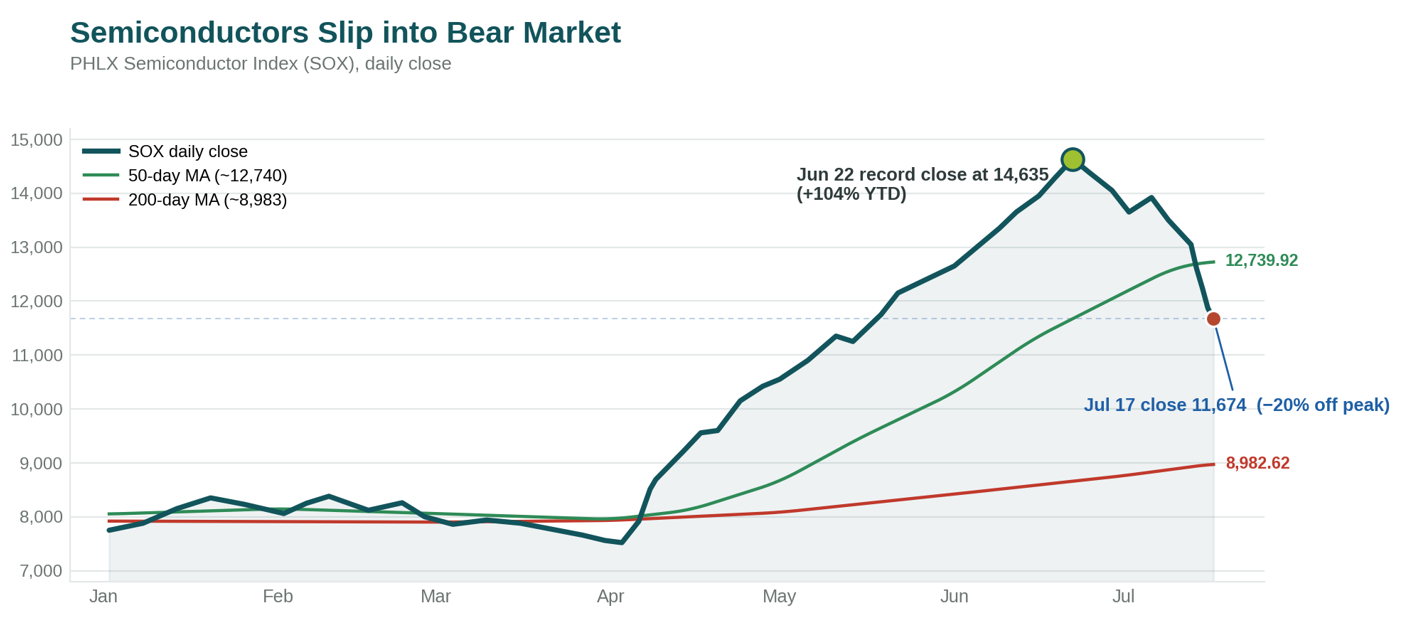
Chart and Commentary by VestGen.